September 11, 2026
Whose Stories Make History? Teaching Black British History Through Billy Waters
What can we learn about a historical period when we shift our attention away from its most famous figures and look instead at a life that has largely been overlooked?
Billy Waters is not a household name, but his life offers a fascinating route into questions of Black British history, identity, poverty, disability and representation. Teachers can now explore his story with students through Billy Waters: Songs from the Shadows, a set of free educational resources featuring a 20-page graphic novel and digital soundscape for young people aged 11–16.
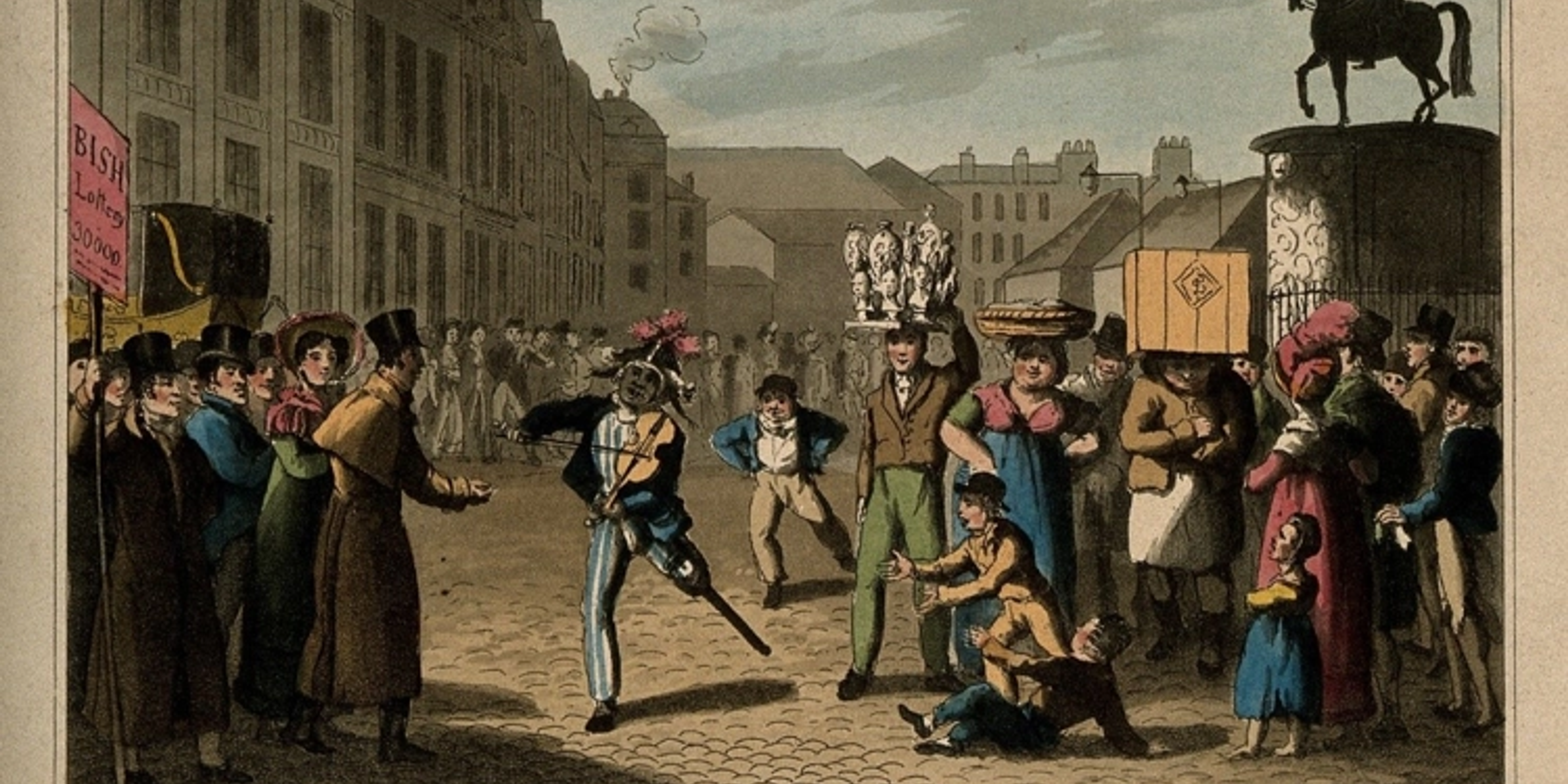
Born in the late eighteenth century, Billy Waters was a Black sailor and disabled veteran who later became a well-known street musician and performer in nineteenth-century London. His life provides a particularly rich lens through which to explore the society in which he lived, and the lives and experiences that have often received less attention in traditional accounts of the past.
The Billy Waters Project brings together historians, artists and musicians (some of whom are our new Researchers of the Month) to explore his story in imaginative and accessible ways. Drawing on the limited and sometimes ambiguous evidence that survives about his life, the resources invite young people not only to learn about Billy, but also to think about how histories are constructed, whose stories are preserved and how power, identity and representation shape the way we understand the past.
Summary
What does the resource pack include?
The things we do know about Billy’s life suggest that it was dynamic and creative, with music playing an important part in his identity. The researchers wanted the resources themselves to reflect this, bringing together history, art, storytelling and music in a multidisciplinary approach.
At the heart of the pack is an engaging 20-page graphic novel about Billy's life which teachers can use in various different curriculum contexts.
Rather than filling gaps in his story or presenting one interpretation as fact, the graphic novel purposefully makes clear what things are known, what things remain uncertain and where different interpretations are possible. At key points, ‘choose your own path’-style features invite pupils to weigh up alternative readings of the evidence. Alongside the graphic novel, the pack includes a song and soundscapes, example lesson plans and curriculum mapping. These provide different ways into Billy's story and the complex ideas it raises, including through visual and musical material as well as written text.
The resources have also been designed to be flexible rather than prescriptive. Teachers can use them as standalone activities or incorporate them into existing teaching across subjects and topics including citizenship/RSHE, abolition, revolution, war and British history.
Implications
Tips for teachers: why use the Billy Waters resources?
You can use these resources to stretch the timeline of Black British history. Billy’s story can help pupils recognise that Black presence in Britain extends much further back than the histories they may encounter most frequently. Rather than treating Black British history as a separate or relatively recent strand, use Billy to locate it firmly within the wider story of British history.
His story also helps pupils encounter a fuller range of Black historical experience. There is hardship and injustice in Billy's life, but his story is not defined solely by these things. It also encompasses talent, fame, family, humour, resilience and community. Billy was Black, disabled, a sailor, performer, husband, father and public figure. His life can help pupils think about the different aspects of identity that coexist within one person and avoid presenting historical figures simply as representatives of a particular group or experience.
You can use the resources across the curriculum, and not only during Black History Month! Billy's story has clear applications in history, but also connects with English, citizenship and potentially drama. It can sit alongside existing teaching about nineteenth-century London, class, inequality, exclusion, identity and belonging.
Use the resources to encourage an interrogation of historical sources. A central idea underpinning the project is that history is ‘curated, not captured’. The past does not record itself: what survives depends on what people chose to record, preserve and pass on. Billy's story makes this particularly visible and encourages pupils to ask who created the sources that survive, why they were created, whose perspectives they represent and how these factors might shape what they tell us.
Use the gaps as well as the evidence. We know frustratingly little about many aspects of Billy’s life. Use these knowledge gaps to encourage pupils to ask why some lives are better documented than others, whose voices are preserved in archives and what historical silences might tell us about the societies that produced them.
Encourage pupils to interrogate representation. Compare what appears to be known about Billy with the fictionalised character that developed around him. This is a great way to open up conversations around who gets to construct somebody’s public identity, how representations can affect reputation and why a particular version of a person might survive more strongly than the person themselves. There are obvious connections here with contemporary celebrity and media culture.
Allow complexity rather than supplying neat answers. There is much about Billy that we simply do not know. Encourage pupils to distinguish between evidence, reasonable inference and imagination. This provides valuable practice in thinking critically about how historical knowledge is constructed and exposes pupils to some of the challenges historians face when researching marginalised lives. Where the archive doesn't provide a clear answer, historians can draw on comparable lives and wider historical context to establish plausible possibilities. Pupils can be encouraged to do the same.
You could use Billy's story as a starting point in larger or potentially sensitive conversations. Billy’s individual story provides a relatively concrete route into much larger conversations about race, disability, poverty, migration, belonging and inequality. Beginning with what happened to one person can make complex or potentially sensitive discussions more accessible without requiring pupils to begin by disclosing their own experiences or political views.
If time is short, start with an image. Show pupils the opening scene or front cover of the graphic novel before telling them who Billy is. Ask what they notice, what they can infer and what questions the image raises. This creates curiosity and gives pupils an immediate role as historical enquirers rather than passive recipients of Billy’s biography.
Use the resources to encourage consideration of questions like:
- Who gets remembered and who gets forgotten?
- What does it mean to forget?
- Is historical forgetting ever neutral?
- What do gaps and silences in an archive tell us about the society that created it?
Listen to our interview with Dr Marsh, Dr Shannon and Himan here.

Dr Ben Marsh, Dr Mary L Shannon and Himan Heidari
Dr Marsh is an Honorary Reader in History at the University of Kent, Dr Shannon is Associate Professor and Disabilities Co-ordinator in the School of Arts, Humanities & Social Sciences at the University of Roehampton, London and Himan Heidari is an AHRC-funded PhD student in English Literature at the University of Roehampton, London
Dr Ben Marsh is a historian with a teaching and research career spanning 25 years across several universities including Oxford, Stirling and the University of Kent (where he is currently an Honorary Reader in History). He is a specialist in the history of the Atlantic World, early America and the Age of Revolutions, and among his award-winning books are Unravelled Dreams: Silk and the Atlantic World, 1500-1840 and Georgia’s Frontier Women: Female Fortunes in a Southern Colony. Besides multiple academic books and articles, in recent years, his outputs have included pioneering creative and educational resources for schools including graphic novels and games. You can reach him at: https://www.stuffofhistory.com/
Dr Mary Shannon is a writer, Associate Professor and Disabilities Co-ordinator in the School of Arts, Humanities & Social Sciences at the University of Roehampton, London. She also has a PGCE in Secondary English Teaching. The award-winning author of Dickens, Reynolds and Mayhew on Wellington Street: The Print Culture of a Victorian Street, her latest book is Billy Waters Is Dancing: Or, How a Black Sailor Found Fame in Regency Britain. Find her at marylshannon.com.
Himan Heidari is an AHRC-funded PhD student in English Literature at the University of Roehampton, London. He is a Research Assistant on the Billy Waters project, where he analyses research data and participant feedback, helps evaluate the project's educational and archival impact, assists with workshop delivery and supports the project's administration.
Dr Ben Marsh, Dr Mary L Shannon and Himan Heidari
Dr Marsh is an Honorary Reader in History at the University of Kent, Dr Shannon is Associate Professor and Disabilities Co-ordinator in the School of Arts, Humanities & Social Sciences at the University of Roehampton, London and Himan Heidari is an AHRC-funded PhD student in English Literature at the University of Roehampton, London
Related Resources


Scroll our research gallery
Oct 14, 2026
How Self-Harm Content Reaches Young People Online
A recent study published by researchers at the University of Oxford’s Department of Psychiatry found that one in three young people had seen self-harm content online in the previous month. Among those exposed, nearly 55% had encountered it once or twice, 26.5% a few times and 18.5% had seen self-harm content several times. The research team, led by our new Researcher of the Month, Dr Holly Bear, analysed data from more than 32,000 students aged 11–18 who took part in the 2025 OxWell Student Survey in England. This is a large school-based survey which runs every two years across England, with participating schools concentrated particularly in Oxfordshire and Liverpool. It asks school students directly about their mental health, wellbeing and their lives more broadly, both online and offline, and provides a rich snapshot of what is happening in young people's lives at that moment. Nearly three-quarters (72.9%) of those exposed had encountered self-harm content through passive routes, without actively seeking it. Algorithmic feed suggestions were the most commonly reported route overall. Even many of the younger survey respondents had encountered content (around one in four 11-12 year olds in the previous month) despite most social media platforms currently having a minimum age of 13.
Aug 14, 2026
Deepfakes and Damage: Helping Schools Respond to AI-Generated Image Abuse
When we hear the word 'deepfake', many of us might think of celebrities, political misinformation, or the kind of AI 'slop' that now features heavily on our social media feeds. We might be less likely to think about school pupils. Yet emerging research suggests that AI-generated sexual deepfakes are an issue that schools increasingly need to understand and be prepared to address. AI-facilitated abuse is a growing concern, with reports of deepfake imagery being used maliciously against both pupils and teachers. Whilst anyone can be targeted, research suggests that sexual deepfake abuse is strongly gendered, with girls and women disproportionately affected. Within UK schools, AI-facilitated image-based sexual abuse most commonly involves groups of boys taking existing photographs of female peers from social media and using generative AI tools to create fake nude images. There have also been reports of criminal gangs targeting schools, threatening to take publicly available images of children from school websites and social media and turn them into sexually explicit images for the purposes of blackmail. In the UK, producing this kind of material is a criminal offence, though globally, laws are not consistent. Whilst deepfake images are not real, the harm they cause is. Emotional, reputational and developmental consequences can be profound and anyone who experiences this form of abuse deserves to be taken seriously and supported. With her team, our latest Researcher of the Month, Professor Tanya Horeck, has recently published one of the first empirical studies to examine AI-generated sexual deepfakes within UK schools. Using qualitative data from interviews with secondary school staff and pupils at eight UK schools, Professor Horeck explored what young people and school staff understand about sexual deepfakes, how schools are currently responding, teachers' confidence and preparedness and what support schools need. The findings revealed significant gaps in knowledge and understanding, alongside a strong appetite among both students and teachers for more information, guidance and education. It's important to note that, as an early qualitative study in a rapidly developing area, the research involved only a small number of participants and was designed to explore experiences and perspectives rather than establish how widespread particular views or practices are.
Jul 14, 2026
What Does Effective Drugs Education Look Like? Lessons from The Illicit Project UK
Our latest Researcher of the Month, Professor Harry Sumnall, is leading a team of researchers at Liverpool John Moores University to adapt and test a school drug prevention programme aimed at older teens (aged 15-18). The Illicit Project UK aims to develop teens' skills so that they can make healthier and safer choices when it comes to drug use, avoiding fear mongering approaches of the past that were designed to scare young people, and which we now know to be ineffective. The programme is fully aligned with the national RSHE curriculum in England and with the health and wellbeing curriculum in Scotland. This evidence-based approach is currently being tested in the North West of England and Scotland. The researchers are still looking for more schools, so if you work in a setting based in these areas and would like to be involved in the trial, please contact us and we'll put you in touch with the research team. You can find out more about what participation involves here.
Jun 16, 2026
Making Feedback More Motivating: Learnings from New Research
We often assume that positive feedback will always encourage people to keep trying hard. However, new research by our latest Researcher of the Month, Professor Nils Jostmann, and his co-author Professor Eddie Brummelman, suggests that praise and encouragement can sometimes have the opposite effect, and that how and when we give feedback really matters. Feeling positive about our progress on a task, or believing that we are doing better than we expected to, can sometimes act as a cue that less effort is needed, causing us to work less hard or 'coast'. Positive feedback may therefore have unintended consequences. Rather than spurring us on, it can sometimes encourage us to ease off because we feel confident that we are already doing well enough. Professor Jostmann's recent research sought to explore this further, examining whether the timing of positive feedback influences whether it boosts motivation or inadvertently undermines performance.

May 22, 2026
Reframing Masculinity: Tips for Parents and Teachers Supporting Boys
Dr King-Hill's research with young people has found that many many boys and young men today are grappling with how masculinity is defined and expressed, and many are struggling. In response, she has recently published We're In This Together, Reframing Masculinity for Young Boys and Men. This free, practical and accessible resource is designed for educators and parents or carers, and is packed with thoughtful guidance and realistic strategies to help the boys and young men growing up in our care to thrive. We'd recommend that all of our Tooled Up parents and educators download and read it.

Apr 14, 2026
Empowering young people to overcome low mood and boost wellbeing
Our latest researcher of the month, Professor Maria Loades, is currently seeking teens aged 13 - 17 to take part in a new study. Her Unlock Wellbeing trial will test the efficacy of digital, single session, self-help interventions, which have been designed to help young people in need of mental health support to feel more hopeful, more in control, and less sad or low. In the UK, there is currently a huge gap between the need for mental health support and access to help for young people. We know from a wide body of research that many young people feel unable to ask for help when experiencing depression symptoms. Whilst around 3% of young people are in contact with Child and Adolescent Mental Health Services (CAMHS) at any point in time, this is only a very small percentage of those impacted by depression, anxiety or stress. In fact, at least one in three young people has at least some symptoms of depression, and one in 10 might meet the criteria for a mental health disorder. There are several reasons why many young people do not seek, or receive, the support they need. Adolescence is a time of growing independence, and many teens prefer to manage difficulties on their own, speak to friends or look online, rather than reach out to adults for help. Although stigma has reduced, concerns about how others might perceive them, and uncertainty about what support is available, can also hold them back. Practical barriers also play a role. School and clinic hours often overlap, and services are not always easily accessible. Alongside this, there is a shortage of trained therapists in the UK, leading to high thresholds for support and long waiting times, even for those who do seek help. Even more interestingly, of those young people who do seek formal support, almost 50% stop attending after just one session. Whilst one session may be sufficient for some, other young people may disengage due to practical challenges, or because the first session did not meet their expectations, even when further support was available. Given the shortcomings of the current model of support, research by Professor Loades and her team has identified a need for additional help that is scalable, barrier free and available on demand. After pilot tests, she's now planning a full randomised controlled trial to evaluate a series of self-guided, digital, single-session interventions for teens, and she's looking for volunteers. The interventions were originally developed by Professor Jessica Schleider in the Lab for Scalable Mental Health in the US, where they showed beneficial effects on symptoms of depression and anxiety as much as nine months after the intervention. They have been adapted by Professor Loades and colleagues for UK use.

Mar 12, 2026
The Universal Classroom: A New Free Screening Tool for Year 1 Teachers
Our latest Researcher of the Month, Professor Joel Talcott, is one of a team of researchers and educators who have worked on a new universal screener for all Year 1 children in the UK, which will be made freely available to all teachers this Autumn. Within the UK education system, formal identification of SEND typically involves ascribing diagnostic labels, such as dyslexia, dyscalculia or ADHD, based on under-attainment in one or more educational outcomes, compared with age-related expectations. However, access to assessment and diagnosis is challenging, and it is currently not equitable for all. The cost of missing children’s needs has serious personal consequences, as pupils underachieve due to unidentified barriers to learning. It also has wider and significant economic costs to society as a whole. Professor Talcott's new universal screener will address this issue. It offers a simple screening tool, which teachers are initially advised to use with all pupils during the first term of Year 1. Supported by government funding through a special educational needs innovation initiative, the Universal Classroom will be delivered via a freely accessible web platform, allowing any school or teacher to use it at no cost.

Feb 17, 2026
Children's Experiences of ADHD
While there have been many empirical studies of childhood ADHD, there have been few qualitative studies investigating first-hand accounts of the lived experiences of children. Much of the literature focuses on the perspectives of parents or teachers, rather than centring children’s voices. But what are children's thoughts, feelings and experiences? Our latest Researcher of the Month, PhD candidate Daphne Ling, has recently published findings which begin to address this research gap.

Jan 19, 2026
The power of reading: books, vocabulary and learning
Did you know that 2026 is the UK’s National Year of Reading? This long-overdue initiative reflects growing concern and renewed commitment around children’s reading and literacy. As Dr Maria Korochkina, our latest Researcher of the Month, puts it: “The ability to read opens up worlds. Reading enables children to progress into post-primary education and provides the basis for lifelong learning and prosperity into adulthood”. Frequent readers tend to have a stronger understanding of both their own and others’ emotions. They are often better able to communicate these emotions, a skill linked to higher emotional intelligence and improved mental wellbeing. Reading also encourages cause-and-effect reasoning and helps children imagine scenarios beyond the immediate moment - developing the skill of -future-thinking'. A rich vocabulary underpins learning across the school curriculum, strengthens thinking and communication skills, and predicts both academic attainment and later life outcomes. Research consistently shows that the most effective way to build vocabulary is through reading. However, learning to read well is not quick or effortless. The journey to skilled reading typically spans around ten years, requiring high-quality classroom instruction alongside sustained practice through independent reading. For many children, this process is painstaking, demanding consistent teaching, encouragement and opportunity over time. Against this backdrop, recent evidence presents a worrying picture. Fewer children are reading for pleasure than ever before. In 2024, only one in three UK children and young people aged eight to 18 reported enjoying reading in their free time. Even more strikingly, just one in five said they read daily for pleasure, the lowest level recorded since the National Literacy Trust began collecting this data in 2005. This matters because reading ability and reading enjoyment are deeply intertwined. Children who find reading effortful are far less likely to choose to read independently. Dr Korochkina’s research highlights how early reading experiences shape later habits: difficulties with phonic and morphological knowledge in the early stages of reading acquisition can have a snowball effect, reducing confidence, fluency and motivation over time. Her work also offers a powerful note of optimism. Books that children actively choose to read, including contemporary, popular texts, provide rich opportunities to develop vocabulary, particularly when children read widely. Ensuring access to a diverse range of engaging reading material, alongside strong early instruction, can play a vital role in building both reading skill and reading motivation. Fostering confident, motivated readers requires long-term commitment. It is not enough for children simply to have books available to them. They need skilled teaching, time, practice and a culture that values reading as both a skill and a pleasure.

Dec 15, 2025
Crossing the line into cybercrime
As the most digitally connected generation so far, young people today face new challenges. Our latest Researchers of the Month, Professor Davidson and Dr Farr, have found that in the last decade, an increasing number of young people (particularly young men) have committed serious cybercrime offences, particularly hacking and money laundering. Their new book, written following a large research project funded by the European Union’s Horizon 2020 research and innovation programme, seeks to understand the drivers behind this trend. It explores a range of potential factors that may lead young people to engage in risky online behaviours, and to identify effective pathways for prevention.